THE ARCHITECTURE
OF OVERREACH
Why High-Net-Worth Egos Crave the Crash

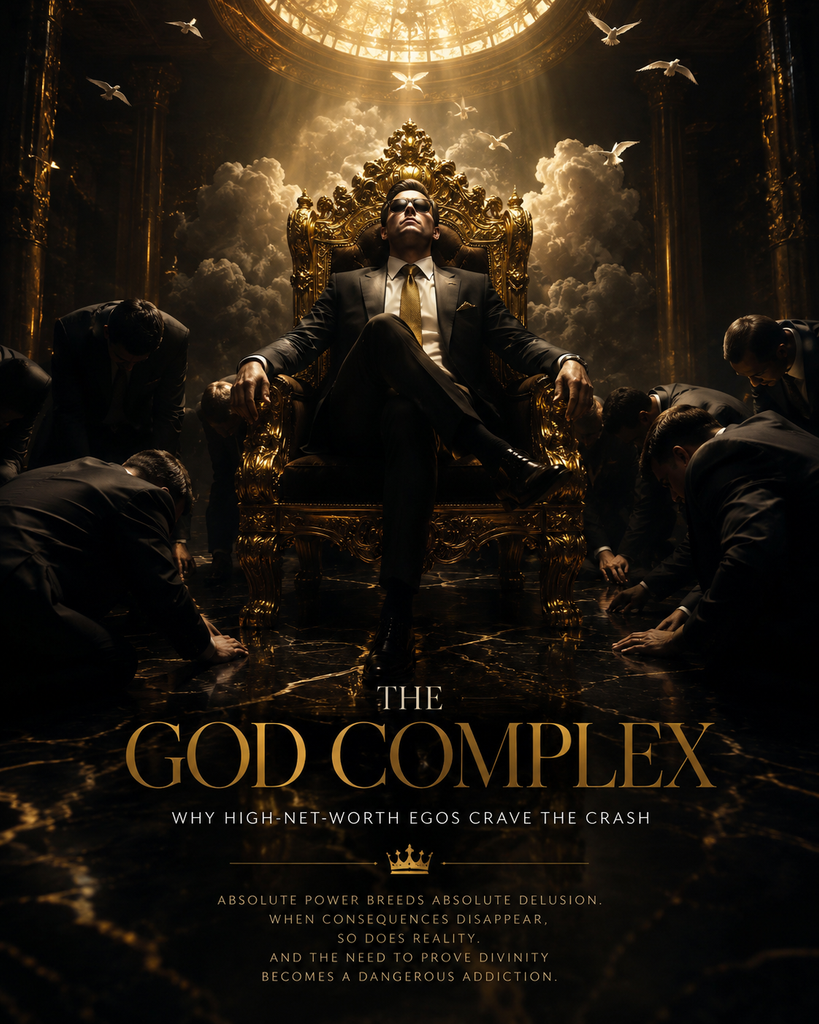
The Golden Throne of Ego
THE GOD
COMPLEX
Why High-Net-Worth Egos Crave the Crash
ower at the highest level is rarely about accumulation; it is about immunity. When an individual crosses a specific financial and social threshold, the standard rules of cause and effect appear to suspend themselves. Consequences become line items, risk becomes abstract, and the surrounding environment converts into a series of managed variables. In this rarefied air, the mind undergoes a fundamental psychological shift: the development of the God Complex. |
The God Complex in high-net-worth ecosystems is not merely inflated confidence. It is a deeply entrenched defense mechanism born from absolute market dominance and total environmental control. When an executive, founder, or operator reaches a point where no one in their immediate orbit can tell them “no,” their perception of reality warps. The absence of external friction leads to a dangerous cognitive feedback loop: they begin to believe that their success is not just a result of market positioning, strategy, or leverage, but a personal infallibility.
Yet, embedded deep within this absolute control is a covert, self-destructive impulse. High-net-worth egos do not just court risk; they secretly crave the crash.
When every outcome is predictable and every reaction is bought, life loses its tension.
The psyche demands friction to feel alive. A controlled environment breeds a subtle form of executive existential dread. To prove their true divinity, the God Complex demands a higher test: the ultimate threat. They do not merely want to win clean games; they want to engineer catastrophic scenarios just to demonstrate that they can walk out of the wreckage untouched.
This is where tactical sabotage finds its entry point.
An opponent operating with a God Complex is paradoxically at their most vulnerable when they feel entirely invincible. They willingly ignore early warning signs, dismantle their own risk management structures, and surround themselves with sycophants who validate their overreach. They view paranoia as a trait for the weak, leaving their flanks wide open.
To neutralize or leverage a God Complex, one does not attack head-on. A direct assault only validates their belief that they are engaged in a heroic battle, feeding their need for high-stakes drama. Instead, the strategy lies in subtle reinforcement. You allow them to believe their overreach is visionary. You supply the mirror that reflects their absolute authority while discreetly removing the floor beneath them. When the crash comes, it is not delivered by an outside enemy—it is engineered by their own uncontained demand for total dominance. They build the trap, step into it willingly, and press the lever themselves, entirely convinced they are about to fly.