TRAVEL • GARDENS • ITALY
The Gardens of Wonder
Where architecture breathes, water becomes art, and Renaissance Italy reveals its most extraordinary secrets.
TRAVEL • CULTURE • ARCHITECTURE
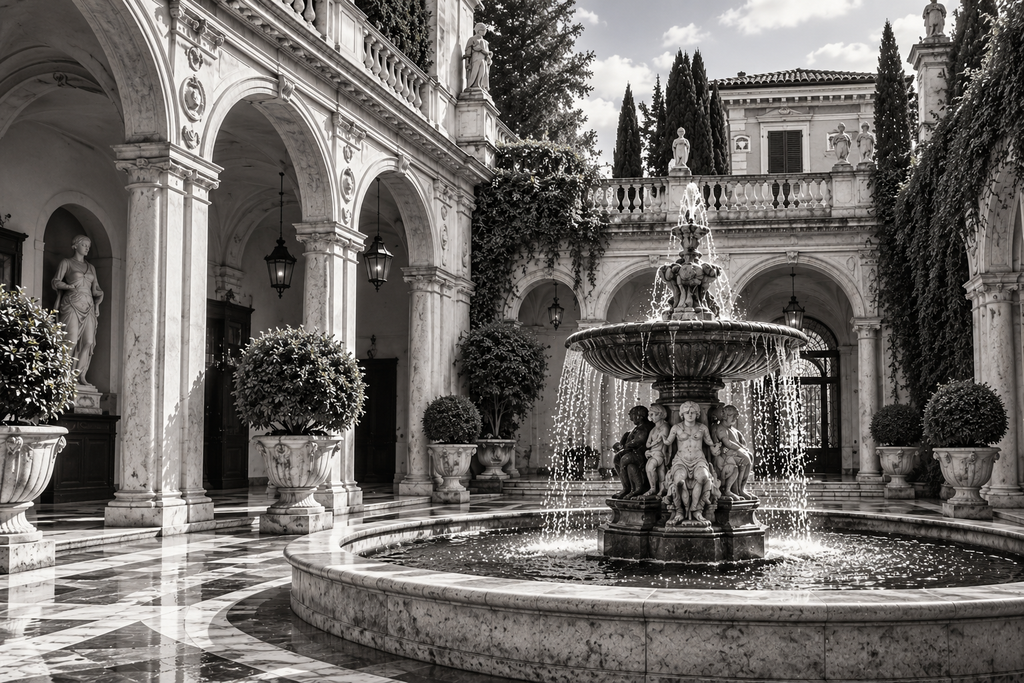
La Fonte di Luce
The Fountain of Light — where Renaissance gardens become theater and water becomes architecture.
There are places in Italy where architecture does not simply surround you—it seems to breathe with the landscape. Water moves through marble. Cypress trees rise behind ancient walls. Fountains become sculpture, gardens become theaters, and sunlight turns stone into something almost luminous.
La Fonte di Luce is our imagined entrance into that world. Inspired by the Renaissance villas and water gardens of central Italy, this journey begins in Tivoli and continues toward Viterbo, where fountains, formal gardens, sculpture and architecture were composed into extraordinary landscapes of beauty and wonder.
The Gardens of Wonder
In Renaissance Italy, a garden could be far more than a place to walk. It could be a statement of power, imagination and artistic ambition. The great villa gardens were designed as living compositions. Water descended through terraces. Fountains marked architectural axes. Sculptures appeared among hedges and grottoes. Stone staircases revealed one view after another. The result was an experience rather than a landscape.
Villa d’Este — Tivoli, Lazio
About half an hour from Rome by car, Tivoli is home to one of Italy’s most celebrated Renaissance gardens. Villa d’Este was commissioned by Cardinal Ippolito II d’Este after he became governor of Tivoli. The gardens were designed by Pirro Ligorio and developed beginning in the 16th century. Water became the soul of the project.
The villa’s gardens descend across the hillside, using the natural terrain and gravity to create an extraordinary sequence of fountains, ornamental basins, grottoes and cascades. UNESCO recognizes Villa d’Este as one of the earliest great Italian “gardens of wonder.” Among its celebrated features is the Fontana del Bicchierone, designed by Gian Lorenzo Bernini in the 17th century.
At Villa d’Este, water is not decoration. Water is architecture.
Villa Lante — Bagnaia, Viterbo
Travel farther north into Lazio and another world of water unfolds at Villa Lante in Bagnaia, just outside Viterbo. Villa Lante is one of the great Italian Mannerist gardens of the 16th century, developed under Cardinal Gianfrancesco Gambara with design traditionally associated with Jacopo Barozzi da Vignola.
Here, the garden unfolds in terraces. Water moves from one level to another, passing through monumental fountains, pools and sculptural compositions. Two nearly symmetrical villa buildings stand at the upper level, while the gardens descend below them. Among the features are the Fountain of the Moors, the Fountain of the Lamps, the Fountain of the Giants, the Fountain of the Chain and the Fountain of the Dolphins.
The garden does not simply contain water. It choreographs it.
Viterbo — The City Behind the Garden
Viterbo offers another reason to linger. Known for its medieval character and connection to the papacy, the city provides a beautiful counterpoint to the highly ordered gardens of Villa Lante. Medieval streets, historic architecture, Italian cafés, gardens and the surrounding Tuscia countryside create an atmosphere that feels removed from the speed of modern travel.
Bomarzo — The Sacred Grove
Not far from Viterbo lies the Sacro Bosco of Bomarzo. Unlike the formal geometry of Villa Lante, Bomarzo takes a stranger, more dreamlike approach. Its Renaissance garden is populated by enormous sculpted figures and fantastical stone creatures hidden among the landscape. It feels less like a traditional formal garden and more like entering an artist’s imagination.
Villa Farnese — Caprarola
For travelers continuing through the region, Villa Farnese at Caprarola offers another extraordinary Renaissance experience. The monumental villa rises above the town and is associated with the powerful Farnese family. Its architecture, interiors and gardens reveal another side of the same Renaissance culture that transformed central Italy into a landscape of villas, fountains, terraces and elaborate gardens.
The Fountain of Light
Our La Fonte di Luce does not exist as a single historic fountain. It is an imagined place. But its spirit is real. It comes from the Italian tradition of turning gardens into experiences—of allowing architecture, water, sculpture, vegetation and light to become part of the same composition.
Perhaps that is why the image feels familiar. It is not one place. It is the memory of many places. A marble courtyard in the morning. Water falling from a carved basin. Cypress trees against a pale Italian sky. A shadow beneath an arcade. The sound of a fountain somewhere beyond the garden. And sunlight moving slowly across stone.
The Journey
For the traveler who wants to experience the world behind La Fonte di Luce, begin in Rome and make your way toward Tivoli. Spend time at Villa d’Este before continuing north through Lazio toward Viterbo and Bagnaia. From there, the journey can expand toward Bomarzo and Caprarola.
This is not Italy experienced in a hurry. It is Italy experienced slowly. One fountain. One garden. One stone staircase. One afternoon at a time.
Maison Adoré Travel Note
If you are drawn to architecture, gardens, fashion, art and the romance of historic Italy, this corner of Lazio belongs on the list. Come for the fountains. Stay for the atmosphere. Leave with the feeling that you have stepped inside a painting.
Maison Adoré