Pseudo Mask of Sanity
There are masks we wear for others, and there are masks we construct for survival.
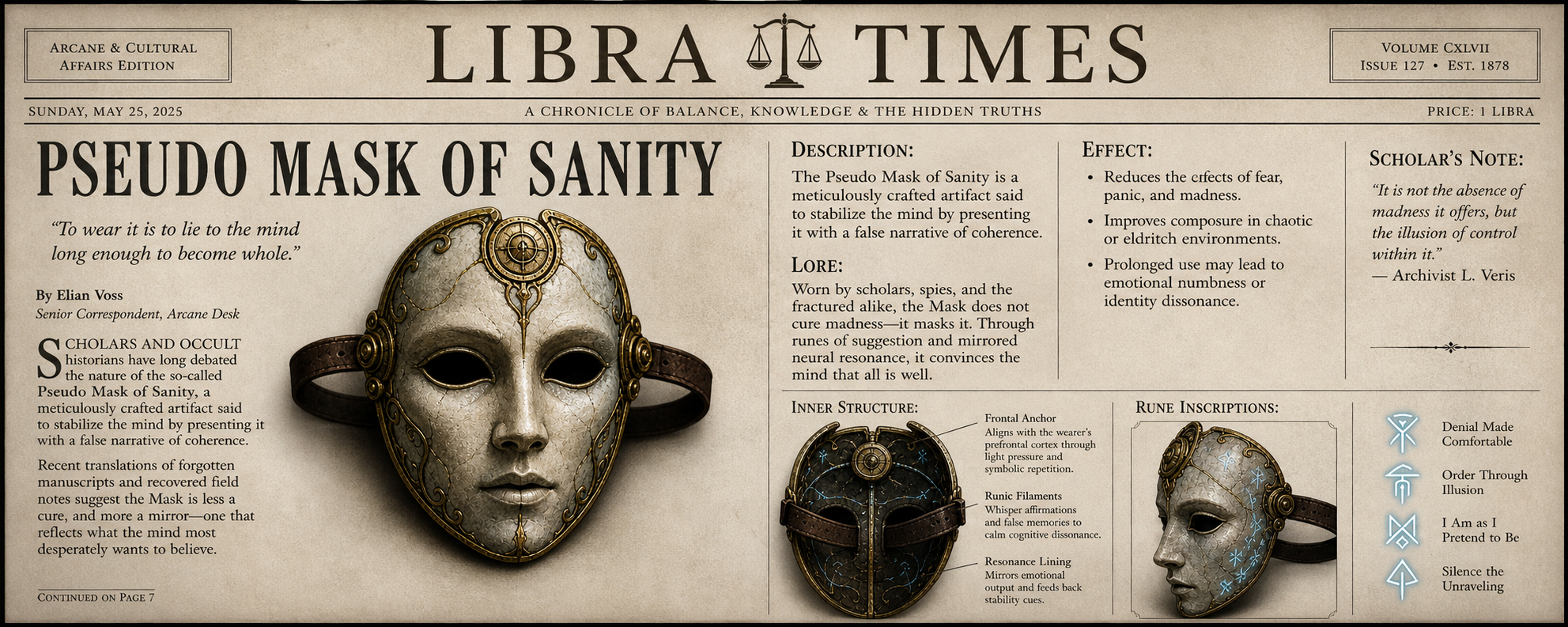
Human adaptation is an extraordinary mechanism. In environments saturated with chaos, unpredictability, or structural hostility, the mind does not simply break; it reorganizes. It builds an interface—a carefully constructed veneer of normalcy, equilibrium, and calm designed to navigate a world that would otherwise overwhelm the psyche. This is the architecture of the pseudo mask of sanity: a functional facade that satisfies the expectations of society while concealing the profound friction occurring beneath the surface.
We often misinterpret these polished facades as indicators of absolute peace. We assume that because someone looks composed, speaks with measured precision, and meets every external demand without visible strain, their internal world is equally orderly. In reality, the most elaborate masks are frequently forged in the deepest fires.
The Utility of the Facade
Wearing a mask is rarely an act of deception for its own sake; more often, it is an instinctual strategy for preservation. When raw vulnerability is met with exploitation or systemic failure, the psyche learns to armor itself in conventionality. It adopts the language of stability, smiles at the appropriate intervals, and mirrors the cadence of safety.
Yet maintaining a pseudo mask requires a relentless expenditure of energy. The greater the dissonance between the internal reality and the external presentation, the heavier the armor becomes. What looks like effortless grace from the outside is often an exhausting internal discipline of containment.
The mask does not hide who you are; it protects what you have left.
Shedding the Armor for Sovereign Truth
There comes a point in every psychological evolution where the cost of wearing the mask begins to outweigh its utility. Survival mechanisms, once vital during times of crisis, eventually become prisons when the storm has passed. True sovereignty requires the courage to drop the performance, to tolerate the discomfort of being misunderstood, and to replace institutional compliance with unyielding authenticity.
When you stop expending energy on maintaining an illusion of seamless normalcy, that energy is redirected inward—reclaiming your focus, your boundaries, and your authority over your own narrative.
Beyond the Veneer
Recognizing the pseudo mask of sanity allows us to look past polished surfaces—both in ourselves and in others—and understand the deeper survival architectures at play. You realize that true strength does not lie in an unblemished facade, but in the capacity to stand unveiled, rooted in your own truth regardless of how the room reacts.
Sanity is no longer about performing correctness for the crowd. It is about quiet alignment with reality, built on a foundation that requires no disguise.
“The truest form of power is found when you no longer need the world to approve your reflection.”
Trust Authority Over Beauty
— La Maison Adoré
The Dangerous Mirror: When Awareness Exposes the Mask
The moment you noticed it, something began to change. Conversations felt staged. Smiles were slightly delayed. You were witnessing a psychological reaction rooted in the mechanics of human cooperation. When you start seeing through motives and power games, you are no longer just an observer—you are a threat to the Pseudo Mask of Sanity that many wear to navigate daily life.
Robert Trivers & Reciprocal Altruism
The Altruism Trap
This dynamic is captured by the work of evolutionary biologist Robert Trivers. His theory of Reciprocal Altruism suggests that human cooperation is built on a delicate system of giving and taking. We enter neighborhoods as “good neighbors,” offering kindness with the expectation of a healthy return.
Trivers noted that if your perception allows you to see through someone’s hidden aggression or inferiority, the “altruism” curdles. They feel exposed even if you never say a word.
The Cost of the Shadow
Carl Jung described the Shadow, but Trivers provided the biological reason why: people protect their self-deceptions to function in society. When you unintentionally reflect their true nature back to them, resentment forms long before logic can interfere.
The Unsettling Truth
Most hatred never announces itself. It hides behind a smile while quietly working against you. This is the “quiet consequence of perception.” You haven’t betrayed anyone; you have simply witnessed the truth.