The unforgettable Canadian artist who made music, individuality, and extraordinary braids part of her signature.
4 Min Read • Music • Beauty • Culture
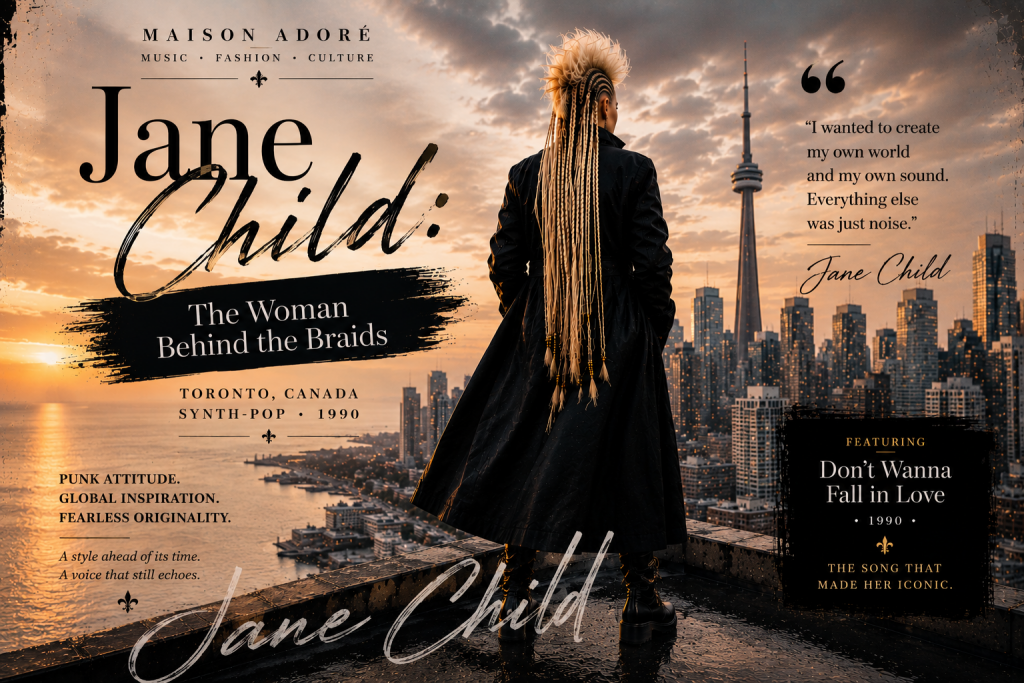
Toronto-born and unmistakably original, Jane Child turned music, style, and individuality into one unforgettable image.
Jane Child: The Woman Behind the Braids
Before the internet made individuality easy to document, Jane Child walked onto the pop scene looking like absolutely nobody else. Born in Toronto into a musical family, Child was not simply a singer waiting for someone else to create her sound. She became a songwriter, producer and multi-instrumentalist whose music and appearance were unmistakably her own.
Then, in 1990, came Don’t Wanna Fall in Love—the song that would make her a familiar face and voice around the world. The single reached No. 2 on the U.S. Billboard Hot 100 for three consecutive weeks, turning Child into one of the most distinctive new figures of the era.
A Sound — And a Look — of Her Own
What made Jane Child so memorable was that the music and the image arrived together. Her signature look combined dramatic spiked hair with extraordinarily long braids and a chain connecting her nose piercing to her ear. It was bold, unconventional and instantly recognizable.
According to biographical accounts, Child’s style drew from African and East Indian cultural influences as well as the punk environment she encountered growing up in Toronto. The hairstyle itself was not a last-minute pop-star makeover; she had developed it years before her breakthrough.
“She didn’t look like she had been styled for pop music. She looked like she had arrived with her own world already built.”
The Woman Behind the Record
There was considerably more happening behind the image. Child’s self-titled debut album was released in 1989, and she was deeply involved in its creation. She handled vocals, keyboards, synthesizers, bass, drums, percussion and programming, with guitar provided by James Harrah. She also produced the album.
That creative independence is part of what makes her story so interesting today. In an era when young female performers were often packaged by record labels and surrounded by teams of writers and producers, Child arrived with an unusually complete artistic identity.
And Then There Were the Braids
For anyone discovering Jane Child through the hairstyle first, the fascination is understandable. Those braids were not a subtle accessory. They became almost architectural—extending dramatically downward while the hair above them rose into sharp, sculptural spikes.
The effect was part punk, part futuristic, part pop and completely unmistakable. It gave Child a silhouette that could be recognized from across a television screen before the audience even heard the first note.
And that is exactly why the look remains worth revisiting. Fashion history is often remembered through clothing, but sometimes it is a hairstyle that freezes an artist in time.
Jane Child — “Don’t Wanna Fall in Love”
The 1990 music video captures Child at the height of her breakthrough, moving through New York City while performing a song she wrote and produced herself.
Jane Child’s mainstream moment may have been brief compared with some of the stars who followed her, but the image never really disappeared. The song remains recognizable, the look remains striking, and the combination of music, independence and visual identity still feels unusually modern.
Perhaps that is why she is such a fascinating woman to begin this Maison Adoré series with. Before the celebrity machine became faster, louder and more carefully constructed, Jane Child simply looked like Jane Child.
Some artists follow the moment. Others leave behind an image the moment cannot forget.
— Maison Adoré
Some artists follow the moment. Others leave behind an image the moment cannot forget.
— Maison Adoré
Christina Aguilera: The Transformation of Xtina
There was a moment when Christina Aguilera stopped being the polished pop princess the world thought it knew. In 2002, she stepped into a radically different version of herself—and the transformation was impossible to miss.
The arrival of Stripped brought darker styling, body jewelry, tattoos, provocative fashion and a much more confrontational attitude. Her alter ego, Xtina, was no longer interested in fitting neatly inside the pop-star image that had made her famous.
The Braids Were Part of the Transformation
Among the most memorable elements of this period were the long braids that appeared throughout her early Stripped era. The braided looks became part of the visual vocabulary surrounding Aguilera’s transformation, particularly around the 2002 MTV Video Music Awards and the arrival of “Dirrty.”
The hair, makeup, clothing and music all worked together. Nothing about the look suggested the sweet, carefully packaged teenager who had arrived with “Genie in a Bottle.” This was an artist deliberately constructing a new identity.
The braids, the attitude and the music arrived together—and Xtina was born.
When the Image Became the Message
The “Dirrty” era became one of the defining visual moments of early-2000s pop. The video, directed by David LaChapelle, pushed Aguilera into a deliberately provocative world of boxing rings, leather, choreography and industrial nightlife.
The transformation was not simply about shock value. Aguilera was moving away from the expectations attached to her first album and establishing control over a much more complicated public identity. The music of Stripped allowed her to explore sexuality, vulnerability, confidence and independence in ways her earlier pop image had not.
A Voice That Was Never the Problem
Beneath all the controversy was something that had been obvious from the beginning: Aguilera could sing. Her enormous vocal range and technically demanding performances had already established her as one of pop’s strongest vocalists.
That is what makes the Stripped era worth revisiting today. The braids, makeup, leather and attitude were visual signals—but the music gave the transformation its lasting power.
The Music Lives On
Stripped remains central to Aguilera’s catalog, alongside albums including Back to Basics, Bionic, Liberation and her Spanish-language projects. Her catalog continues to be available across major music platforms.
Christina Aguilera — “Dirrty”
Revisit the video that introduced Xtina and explore the music behind one of pop’s most recognizable transformations.
More than two decades later, the Stripped era remains instantly recognizable. The music continues to circulate, the fashion continues to inspire, and the image of Christina Aguilera with long braids remains permanently connected to one of pop’s most dramatic reinventions.
Some eras become memories. Others become visual language.
— Maison Adoré
Ke$ha: The Wild Side of Pop
When Ke$ha arrived, she did not look like another perfectly polished pop newcomer. She arrived with glitter, attitude, unconventional beauty and a style that seemed determined to exist outside the traditional rules of pop.
The dollar sign in her name became part of the character. So did the messy makeup, metallic details, rebellious clothing and hairstyles that changed with the mood. During this early period, her braided and cornrow looks became another unmistakable part of the visual language surrounding her music.
When the Braids Became Part of the Look
For Maison Adoré, this is where Ke$ha becomes particularly interesting. We are not simply looking for an artist who wore braids once. We are looking for a musician whose hairstyle contributed to a recognizable visual moment.
In the video featured with this story, Ke$ha appears with cornrow-style braids that fit naturally into the unruly, rebellious aesthetic of her early career. The hairstyle works with the music rather than sitting separately from it.
The hair was part of the attitude—and the attitude was part of the music.
The Arrival of Ke$ha
Ke$ha first made a major impression through her appearance on Flo Rida’s “Right Round” before breaking through on her own with “TiK ToK.” Her debut album, Animal, arrived in 2010 and established her as one of pop’s most distinctive new personalities.
Songs such as “Your Love Is My Drug,” “Take It Off” and “TiK ToK” helped define the sound of the moment, while Cannibal continued the same irreverent energy with “We R Who We R” and “Blow.”
Her catalog has since expanded dramatically. Apple Music currently lists releases ranging from Animal and Cannibal to Warrior, Rainbow, High Road, Gag Order and her newer independent work.
A Pop Image That Refused to Behave
Ke$ha’s early appeal came partly from her refusal to look overly manufactured. She could be glamorous, chaotic, funny, provocative and deliberately messy—all within the same pop universe.
That freedom extended to her hair. Braids, loose waves, wild volume and unconventional styling could all exist within the same era because the point was never perfection. The point was personality.
And that is precisely why this particular braided look belongs here. The video gives us the evidence: the music, the era and the hairstyle occupying the same visual space.
Ke$ha — The Braided Era
Watch the video that brings the braided look directly into the story, then continue exploring Ke$ha’s music across the major listening platforms.
The name eventually became simply Kesha, but the early Ke$ha era remains one of the most recognizable chapters of her career. The music was loud, the styling was deliberately unpredictable, and the entire persona seemed designed to make conventional pop expectations feel optional.
That is what makes the braided image worth remembering. It is not simply a hairstyle from another decade. It belongs to the sound, the attitude and the unmistakable visual world of an artist who arrived determined to make her own rules.
Some artists follow the pop moment. Others become the look of it.
— Maison Adoré
Katy Perry: Pop, Fashion & the Art of the Music Video
Katy Perry has always understood that pop music can be bigger than the song itself. Her music arrives with costumes, color, beauty, choreography and elaborate visual worlds—and few videos demonstrate that instinct more clearly than This Is How We Do.
Released in 2014 as the fifth single from Prism, the video transformed Perry into a moving pop-art collage. One moment she appears in a brightly colored fashion look; the next brings another costume, another setting, another visual joke. The result is less a traditional narrative than a rapidly changing fashion and pop-culture playground.
The Cornrows Were Only One Moment
Among the many beauty transformations in the video is a brief cornrow look paired with bleached eyebrows. Fashion coverage at the time specifically singled out the combination while cataloguing the video’s extraordinary collection of clothing and beauty references. :contentReference[oaicite:2]{index=2}
The hairstyle may occupy only a moment of the larger production, but that is precisely what makes the video interesting for Maison Adoré. The braid is not the entire story. It becomes one detail within a much larger visual language of fashion, beauty and performance.
In Katy Perry’s world, a music video could become its own fashion universe.
A Video Built Around Fashion
This Is How We Do moves through an extraordinary collection of visual references: graphic prints, colorful tailoring, exaggerated accessories, playful beauty looks and surreal props. TIME described the video as a showcase for Perry’s over-the-top visuals and outrageous outfits. :contentReference[oaicite:3]{index=3}
The production was intentionally designed as a series of visual vignettes. Director Joel Kefali approached it as pop art, moving between live action, animation, props and highly designed sets. :contentReference[oaicite:4]{index=4}
That makes the video particularly valuable to a fashion-minded publication. There is something new to notice almost every few seconds.
The Katy Perry Visual Language
Perry’s career has repeatedly connected music with visual spectacle. From the candy-colored world of California Gurls to the theatrical imagery of Dark Horse and the futuristic styling surrounding later projects, she has treated the music video as another form of creative expression.
Apple Music describes Perry’s career as one built around a highly recognizable combination of music, image, playfulness and visual confidence. Her catalog now spans albums including One of the Boys, Teenage Dream, Prism, Witness, Smile and 143. :contentReference[oaicite:5]{index=5}
More Than a Braid
For Maison Adoré, the appeal of this particular moment is not about pretending the braid was the defining hairstyle of Katy Perry’s career. It wasn’t.
Instead, it is about recognizing a memorable beauty detail inside a video that was overflowing with fashion. The cornrows become one piece of a much larger picture—and the picture is what makes the feature worth watching.
Katy Perry — “This Is How We Do”
Step into one of Katy Perry’s most visually extravagant music videos, then continue exploring the music behind the spectacle.
Katy Perry’s greatest visual strength has always been her willingness to make pop look like something larger than life. This Is How We Do is a perfect example: music becomes fashion, fashion becomes spectacle, and spectacle becomes entertainment.
And somewhere inside all that color, movement and beautiful chaos, there is the braid—the small detail that brought her into our Maison Adoré conversation.
Sometimes the smallest detail is what makes you stop and look twice.
— Maison Adoré